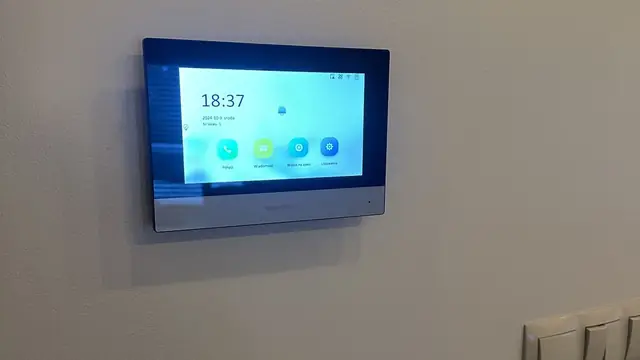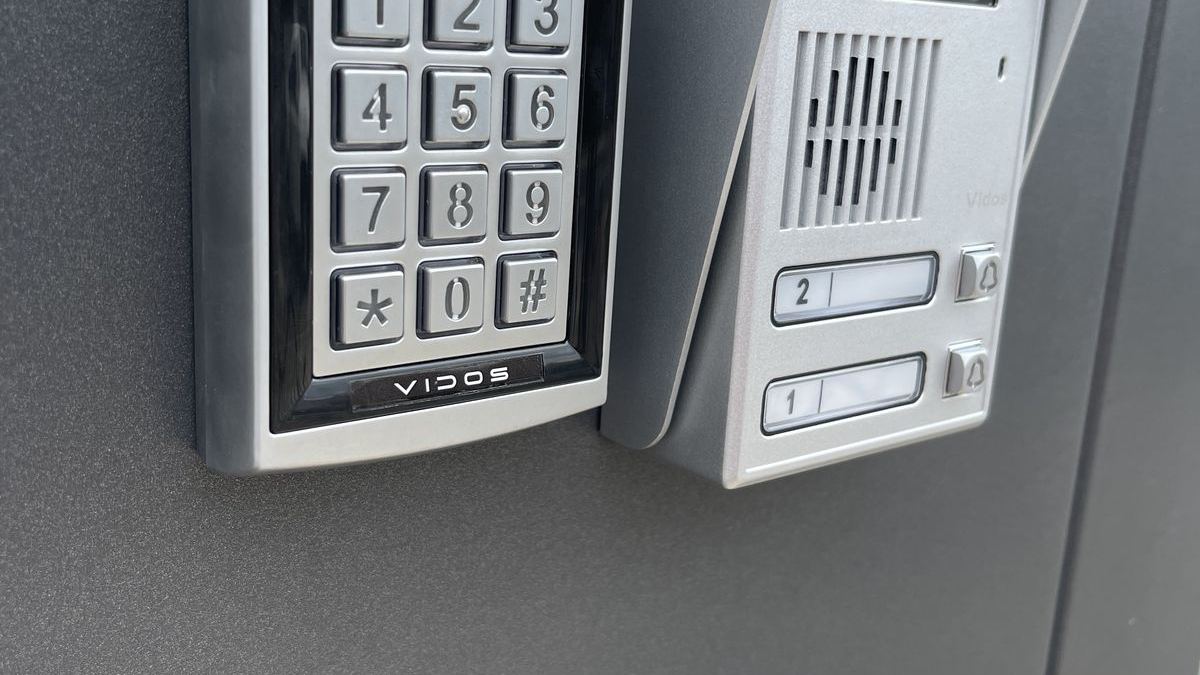
Many blocks of flats in and around Bielsko-Biała still have intercoms installed a dozen or several dozen years ago. Crackling sound, worn buttons, lost keys to the stairwell door – this is everyday life for many residents. A video intercom in a block of flats or housing community is an upgrade that improves security and comfort, but it needs good planning. In this article we explain how to approach replacing the system, what to look out for and who makes the decision.
Why replace an old intercom with a video intercom?
Old audio systems have several typical problems: poor sound quality, frequent handset failures, no way of checking who is at the door and limited access control options. A modern system gives residents:
- A view of the person at the entrance – residents can see who they are letting in, which reduces admitting random people, door-to-door sellers or people posing as “gas company workers”.
- Convenient keyless entry – proximity fobs, cards or codes instead of traditional keys.
- Easy access management – a lost fob can be blocked without replacing the door lock.
- The option to answer calls on your phone in systems that support it.
- Better looks – a new panel at the entrance improves the appearance of the building.
Video intercom or an upgraded audio intercom?
Not every housing community needs a full video system in every flat straight away. A common and sensible solution is to replace the outdoor panel with a modern one with a camera and proximity reader, while keeping the option of continuing to use the audio handsets. Residents who want to see the picture can then install a monitor in their flat, while the rest use their existing handset. Whether this option is possible depends on the system and the condition of the existing installation – this has to be assessed on site.
Proximity readers and access control
An RFID reader in the entrance panel is standard today. Residents receive fobs or cards that open the stairwell door, and often also the gate, the underground car park or the bicycle room. Advantages:
- each fob can be assigned to a specific flat,
- a lost or unreturned fob can be blocked in the system,
- limited access can be granted, e.g. to a cleaning company or the postman,
- some systems provide an entry history.
It is worth paying attention to the card standard. Older, popular fobs are easy to copy, so where security matters it is better to consider encrypted credentials. Administration is also important – who will add and remove fobs: the property manager, the administrator or a designated board member.
Privacy and protection of residents’ data
The camera in the video intercom panel captures the image of people entering the building. If the system only displays the picture during a call, things are simpler. If, however, the picture is recorded and the property manager has access to the recordings, data protection rules (GDPR) come into play. In practice this means, among other things, the need to put up signs marking the recorded area, and to define the purpose and retention period of the recordings and who has access to them.
The second issue is privacy between neighbours. A resident should see the picture only when someone calls their flat, not have a constant view of the entrance. Most systems work exactly like this, but it is worth confirming at the equipment selection stage. Legal details are best discussed with the property manager or the lawyer who serves the community. If the community is also planning cameras in the stairwells and car park, see our CCTV monitoring service.
Who decides on replacing the intercom?
How the decision is made depends on how the building is managed, and it is worth establishing this at the very beginning.
Housing community (wspólnota mieszkaniowa)
In a housing community, decisions that go beyond the ordinary management of common property – which usually includes upgrading an installation financed from the repair fund – are taken by a resolution of the flat owners. The resolution can be adopted at a meeting or by collecting votes individually. In small communities the rules may differ, so it is worth checking the procedure with the property manager.
Housing cooperative (spółdzielnia mieszkaniowa)
In a cooperative, decisions on upgrading installations are taken by its governing bodies, usually the management board, in line with its statutes and renovation plan. Residents can report the need for replacement, e.g. through the estate council or the administration office.
In both cases it is worth finding out residents’ expectations beforehand and preparing a specific proposal – this makes voting easier and cuts down on debate.
How to plan the upgrade step by step?
- Inspection of the existing installation – the installer checks the cabling and the condition of the door, the electric strike and the door closer. This determines whether the existing wiring can be reused.
- Defining needs – just a new panel with a reader, or a full video system in every flat? How many entrances, side gates and gates need to be covered?
- Choice of technology – digital systems on the existing wiring, or IP systems if the building has or plans structured cabling. For new developments it is worth thinking about shared network infrastructure – we help with this as part of our LAN installation service.
- Quote and decision – preparing a quote with options, presenting it to residents and adopting a resolution or a board decision.
- Installation schedule – the replacement is usually carried out in stages so that residents are left without a working intercom for as short a time as possible.
- Handing out fobs and instructions – a list of flats, assigning credentials, brief instructions for residents.
- Servicing – agreeing who reports faults and who manages the access control system.
What to look for when choosing a contractor?
Upgrading the intercom in a multi-family building is a task for years to come, so besides the price it is worth assessing a few other things. Check whether the contractor offers equipment with available spare parts, whether they will hand over documentation and administrative access to the system to the community, and what after-installation service looks like. It is good when the quote includes several options that are easy to present to residents at a meeting.
Monitors in flats – individually or for everyone?
The community often finances the common part: the outdoor panel, the riser cabling and access control. Monitors in flats may be included in the upgrade for everyone, or installed at the request and expense of individual residents. Both approaches are common, and the choice depends on the budget and what the community agrees. It is important to choose a system from the outset that allows monitors to be added later without rebuilding the whole thing.
You can read more about the solutions we install on our intercoms and video intercoms page.
CSAFE upgrades intercoms and video intercoms for housing communities and multi-family buildings in Bielsko-Biała and the surrounding area, including Żywiec, Kęty, Andrychów, Skoczów, Czechowice-Dziedzice, Pszczyna, Cieszyn and Oświęcim. We will inspect the installation and prepare a free quote with options to present to residents. Call 505 298 048 or contact us.
Frequently asked questions
Does replacing the intercom in a block of flats require replacing all the cabling?
Not always. Many digital systems can use the existing wiring, but the decision should be made after the installer has inspected the installation.
Who decides on installing a video intercom in a housing community?
Usually the flat owners, by resolution, because the upgrade goes beyond ordinary management. In a cooperative, the decision is taken by its governing bodies in line with its statutes.
Do all residents need a video monitor?
No. Often the outdoor panel is replaced with a video panel with a reader, and residents decide individually whether to install a monitor or keep their audio handset, if the system allows it.
What if a resident loses their proximity fob?
The lost fob is blocked in the access control system and a new one is issued. There is no need to replace the lock on the stairwell door.