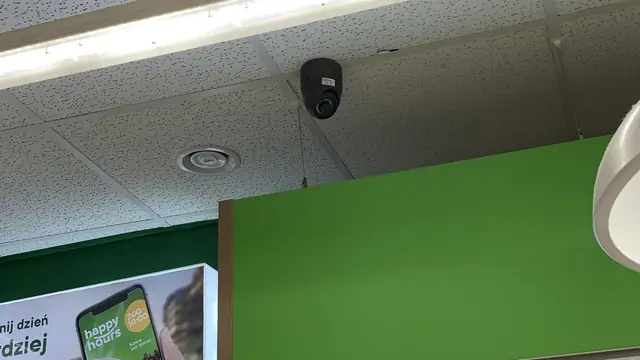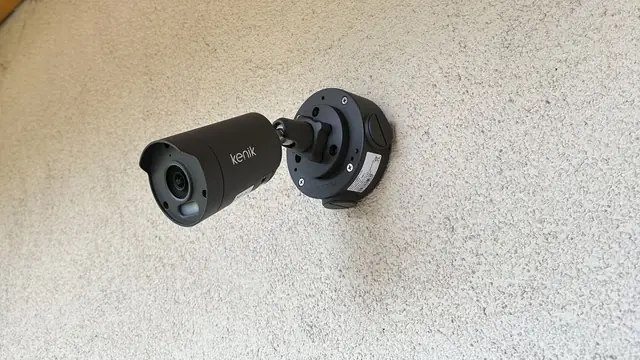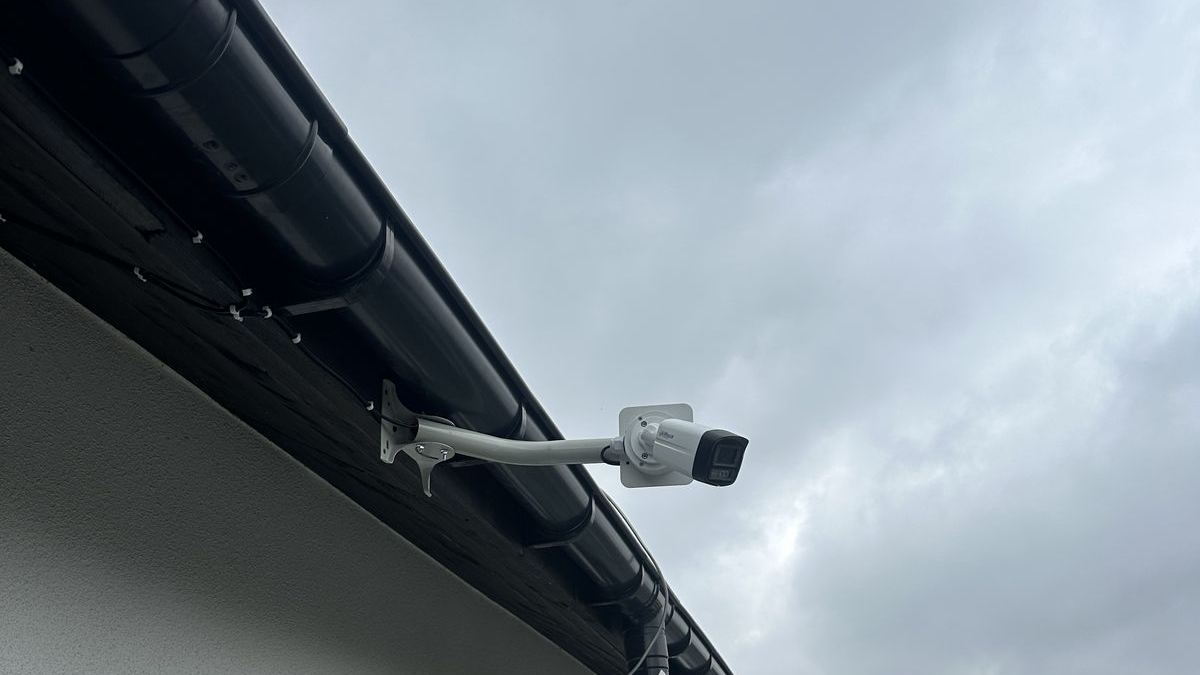
"How much does home CCTV cost?" – that is the question we hear most often, even before a client shows us their property. The honest answer is: the price of home CCTV depends on the design. Two seemingly similar four-camera installations can differ in cost several times over, because running cables in a new house with empty conduits is quite different from doing so in a finished building with a clinker brick façade. In this article we explain what makes up the cost of installing cameras in 2026 and what to look out for when comparing quotes.
Home CCTV – the price depends on a few key factors
Every CCTV quote is the sum of several elements: equipment, installation materials, labour and configuration. Each of them is affected by decisions worth making consciously. Below we discuss them one by one.
1. The number of cameras and what they need to see
The starting point is the question of what you want to protect. Covering the driveway and front door is designed differently from full coverage of the garden, garage, terrace and plot boundaries. More cameras mean not only more devices but also more cables, mounting points and recorder ports. A good design can often reduce the number of cameras – e.g. one well-positioned camera with a varifocal lens can replace two poorly placed ones.
2. Camera type: resolution, lens, night vision
Cameras differ in resolution, sensor quality, lens type and how they cope after dark. The cost is affected by, among other things:
- resolution – 4 MP is a sensible standard today, while 8 MP (4K) is useful where details need to be recognised from a distance;
- lens – a fixed wide-angle lens is cheaper, while a varifocal (motorised zoom) lens allows the frame to be set precisely;
- night vision – standard infrared gives a black-and-white image, while technologies such as Full Color (Dahua) or ColorVu (Hikvision) show colour at night as well;
- analytics – cameras with human and vehicle detection (e.g. Dahua WizSense, Hikvision AcuSense) cost more but significantly reduce false alarms;
- housing type – bullet, dome, turret or a rotating PTZ camera that can be controlled remotely.
3. Technology: IP or HD analogue cameras
For new installations we most often propose IP cameras. They transmit the image digitally over twisted-pair cable, offer higher quality and richer features, and the system is easy to expand. HD analogue solutions (HDCVI, TVI) can be more cost-effective when upgrading an old CCTV system where coaxial cable in good condition is already run through the walls – in that case replacing the cameras and recorder can be cheaper than new cabling. That is why we always check what is already in the building before quoting.
4. Recorder and hard drive
The recorder (an NVR for IP cameras or a DVR/XVR for analogue ones) is the heart of the system. Its price depends on the number of channels, supported resolution, built-in PoE ports and intelligent analysis features. Equally important is the hard drive. Its capacity is chosen according to the number of cameras, the resolution, the codec (H.265 takes up noticeably less space than H.264) and whether recording is to be continuous or only on motion detection. If you want to keep recordings for several weeks, you will need a larger drive – or two. For CCTV we use drives designed for continuous operation, not ordinary computer drives.
5. Cabling – length and difficulty of the runs
This is the element that makes quotes differ the most. The cost of labour and materials is affected by:
- the length of the cable runs from the cameras to the recorder;
- whether the house is at the shell stage or finished;
- the possibility of running cables through the loft, attic or existing conduits;
- the need to drill through thick walls, insulation or the façade;
- cameras on the fence, gate or an outbuilding, which require cable to be laid underground;
- the use of trunking, cable covers or protective conduits so that the installation looks neat.
The cheapest and neatest option is to plan CCTV at the construction stage, when cables can be laid before plastering. If you are building a house, it is worth considering it together with a LAN network installation, as the two installations complement each other well.
6. PoE power and power backup
IP cameras are usually powered via PoE, i.e. through the same cable that carries the image. This simplifies installation but requires a recorder with PoE ports or a separate PoE switch with a suitable power budget. It is also worth considering a UPS – it keeps the recorder and cameras running during a short power cut and protects the drive from the effects of a sudden shutdown.
7. Remote access and integrations
Most clients want to view the image on their phone. Configuring the app (e.g. DMSS for Dahua or Hik-Connect for Hikvision), push notifications and user accounts is part of the work we include in the service. If the system is to work with an alarm system, a video intercom or an existing Wi-Fi network, the scope of configuration grows. We also pay attention to security – we avoid opening ports on the router and set strong passwords.
8. Warranty, servicing and support after installation
The price is not just about installation day. It also matters who will help when, a year later, a camera needs to be repositioned, a new user added to the app or a drive replaced. When comparing quotes, check whether the installer provides a warranty on the work carried out, what the warranty service for the equipment looks like and whether the company is local, i.e. able to get to you quickly.
Why can two quotes differ so much?
The cheapest quote often means compromises: cameras with weaker sensors that show blurred figures at night, a drive too small to store recordings for more than a few days, cables run along the façade without protection, or no remote access configuration. On the other hand, an overly elaborate quote may include features you will never use. That is why, instead of comparing amounts alone, compare:
- the specific camera and recorder models;
- drive capacity and the stated recording retention time;
- how the cabling is run;
- the scope of configuration and user training;
- warranty and service terms.
How to prepare for a quote?
Before booking a site visit, think about a few things. Which places matter most to you – the driveway, the door, the garage, the garden? Do you want to recognise faces and number plates, or is a general view enough? How long should recordings be kept? Are you planning to expand in the future, e.g. with more cameras or an alarm? The answers to these questions allow us to prepare a design tailored to your needs rather than to a catalogue.
At CSAFE we always start with a site visit. We look at the property, check possible cable routes, propose camera positions and only then prepare a quote. We work with equipment from brands such as Dahua and Hikvision, and you will find details of our offer on the CCTV page.
Summary
The price of home CCTV in 2026 depends on the number and type of cameras, the chosen technology, the recorder and drive, the difficulty of the cabling, power supply, the scope of configuration and the service terms. It cannot be reliably quoted "over the phone" without seeing the building – which is why the best next step is a free quote after a site visit.
Our area: Bielsko-Biała and the surrounding area: Żywiec, Kęty, Andrychów, Skoczów, Czechowice-Dziedzice, Pszczyna, Cieszyn and Oświęcim. We will come over, advise you and prepare a free quote for CCTV at your home. Call 505 298 048 or write to us via the contact form.
Frequently asked questions
How much does home CCTV cost including installation?
There is no single rate, because the price depends on the number and type of cameras, the length and difficulty of the cabling, the recorder and the expected retention period. We give the exact cost after a free site visit and preparing a design.
Do you charge for a CCTV quote?
No. At CSAFE we come to your property, look around, propose camera positions and prepare a quote free of charge and with no obligation.
Is it better to choose IP or HD analogue cameras?
For new installations we usually recommend PoE-powered IP cameras, as they offer better image quality, analytics features and easy expansion. HD analogue can make sense for upgrades where the building already has working coaxial cabling.
Are Wi-Fi cameras a cheaper alternative?
A single Wi-Fi camera may be cheap to buy, but it depends on network coverage and usually does not provide the same stability as a wired installation. For monitoring an entire property we strongly recommend wired cameras.