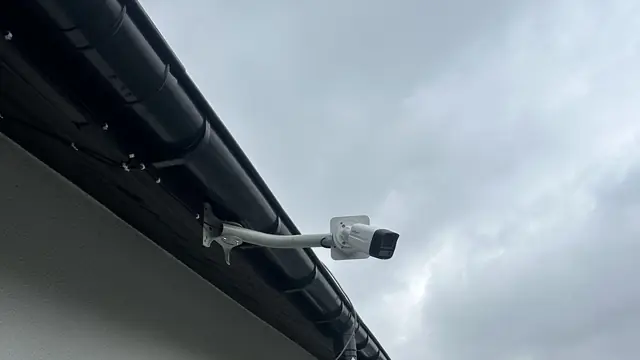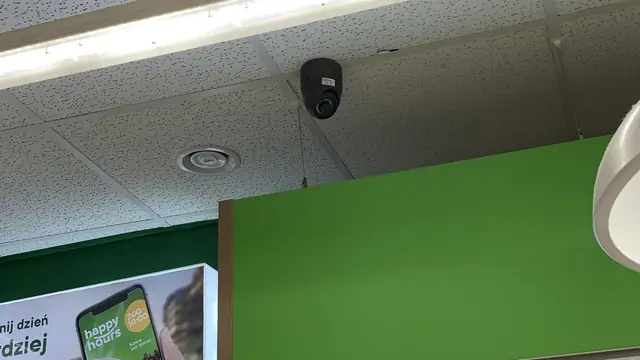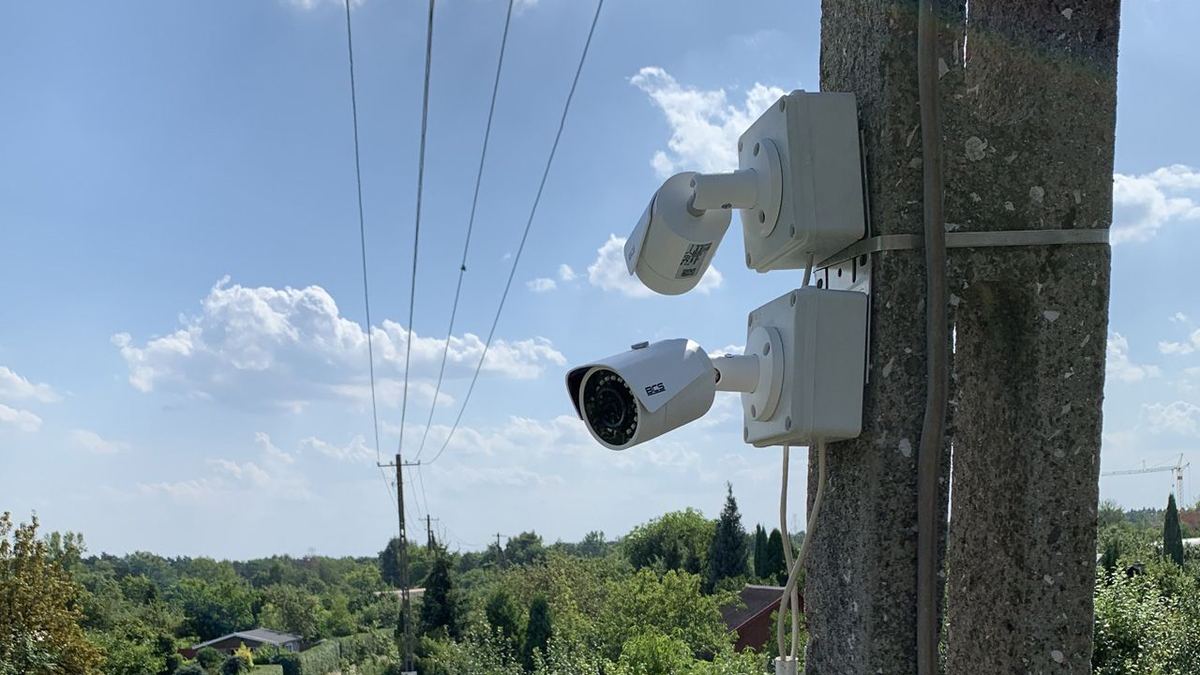
Theft of materials and tools from building sites and break-ins to garden sheds on plots are a problem that many property developers and owners come to us with. The difficulty is that such places often have neither power nor internet. The solution is monitoring a plot or building site without mains power, based on a camera with a 4G/LTE modem powered by a solar panel. We explain how such a kit works, how to choose it and what to watch out for so that it also performs in winter.
How monitoring a plot or building site without power works
A typical kit consists of several elements:
- a camera with a 4G/LTE modem – sends video and notifications over the mobile network using a SIM card;
- a solar panel – charges the battery during the day;
- a battery – built into the camera or external, powers the device at night and on cloudy days;
- a charge controller – protects the battery against overcharging and deep discharge (built into integrated kits);
- recording media – a microSD card in the camera and/or the cloud.
The market offers both compact cameras with a built-in battery and a small panel, and larger kits with a separate panel, a battery box and an IP camera. The manufacturers we work with, including Dahua and Hikvision, offer 4G solutions with solar power. The choice depends on how long the monitoring is to run, how many cameras are needed and what image quality you expect.
Data transmission and the SIM card
A 4G camera needs a SIM card with a data plan. Before installation it is worth checking the coverage on site – not just “is there a signal”, but what its quality is with a specific operator. In foothill areas, of which there are plenty in our region, the differences between networks can be large. Sometimes switching operator or adding an external antenna is enough to make the connection stable.
Data usage depends on several factors:
- resolution and codec (H.265 saves bandwidth);
- the number of events and clips sent;
- how often you watch the live view;
- uploading recordings to the cloud.
The most economical mode is recording to the SD card and sending only notifications, with the live view opened only when it is really needed. We match the data plan to the way you use it – it is better to have some headroom than a camera that loses its connection halfway through the month.
Choosing the battery and panel for winter
This is the most important and at the same time the most often overlooked element. In summer almost any kit works without a problem. The real test comes in November, December and January, when the days are short, the sky is overcast and low temperatures reduce the battery’s available capacity.
When selecting a kit, we take into account:
- the camera’s power consumption – both at rest and while recording, and with infrared switched on at night;
- operating mode – a camera recording continuously uses much more energy than one that wakes up on an event (many battery cameras use a PIR sensor to wake up);
- autonomy – the battery should last for several consecutive days without sun;
- panel output – in winter a panel produces a fraction of its summer energy, so it needs an adequate margin;
- panel positioning – a southern orientation and a steeper tilt in winter help collect more light and make it easier for snow to slide off;
- shading – trees, a building or scaffolding can block the panel for part of the day, especially when the sun is low.
In winter it is also worth switching the camera to a more economical profile: event-only recording, shorter clips, less frequent live viewing. The panel should be cleaned of snow and construction dust from time to time.
Protecting the camera itself from theft
On a building site the risk is not only theft of materials but also theft of or damage to the camera. A few proven rules:
- mount the camera and panel high up, out of reach – on a pole, mast or the wall of a building;
- use sturdy brackets and security screws that are hard to undo with an ordinary tool;
- position the camera so that it can also see its own mounting point, or use a second camera to watch the first;
- use connection-loss notifications – a camera suddenly disappearing from the network is a signal to check what is going on;
- put up signs saying the area is monitored, which acts as a deterrent.
Recording to an SD card or in the cloud?
A microSD card is a solution with no extra fees and no load on the data plan. Its weakness is that it sits inside the camera – if a thief takes the camera, you lose the recordings too. Choose cards designed for surveillance that can withstand continuous writing.
The cloud protects recordings from being lost together with the device and gives quick access from your phone. However, it means additional data usage and often a subscription with the manufacturer. A sensible compromise is continuous or event recording to the card, uploading only short clips or snapshots of detected events to the cloud.
Formalities and permissions on a building site
If the camera on a building site also covers neighbouring plots or a public road, remember other people’s privacy. It is best to limit the frame to your own land and, if necessary, use privacy masking zones. When construction crews are working on site, it is a good idea to inform them about the monitoring and put up a sign. Where construction is run by a company, rules on employee monitoring and GDPR may also apply.
AI cameras on a building site
On a building site, notifications about every movement quickly become a nuisance – plastic sheeting flaps in the wind and animals run around. That is why it is worth choosing a camera with person and vehicle detection. This reduces false alarms and saves both data and energy, because the camera sends fewer clips. Some models also have a light and a siren for active deterrence.
What happens once construction is finished?
A 4G kit with solar power is mobile, so once the project is completed it can be moved elsewhere. In a new house, people usually switch to a permanent wired CCTV system with a recorder, and often also to an alarm system. If you plan the camera cabling during construction, later installation will be quicker, cheaper and neater.
Summary
A lack of power and internet does not rule out effective monitoring of a plot or building site. The key factors are: good mobile network coverage, an appropriate data plan, a battery and panel chosen with winter in mind, secure camera mounting and a well-thought-out way of storing recordings.
Our area: Bielsko-Biała and the surrounding towns – Żywiec, Kęty, Andrychów, Skoczów, Czechowice-Dziedzice, Pszczyna, Cieszyn and Oświęcim. We will check the coverage on your plot, select the right kit and prepare a free quote. Call 505 298 048 or contact us.
Frequently asked questions
Will a solar camera work in winter?
Yes, provided the panel and battery are sized for short, cloudy days and the panel is set at the right angle. In winter you usually also need to limit the operating mode, e.g. record only events instead of continuously.
How much data does a 4G camera use?
It depends on the resolution, the number of events and how often you watch the live view. A camera recording to an SD card and sending only notifications uses little, while frequent live viewing significantly increases data usage.
Where are recordings from a 4G camera stored?
Most often on a microSD card in the camera, sometimes additionally in the manufacturer’s cloud. The card generates no transmission costs but can disappear together with the camera; the cloud protects recordings against theft of the device.
Can a building-site camera be moved later?
Yes, 4G kits with solar power are mobile by design. Once construction is finished, they can be moved to another plot or replaced with a permanent wired CCTV system.